25 Million Loss for Fiji Airways in 2024
FIJI NEWSTOP STORIES
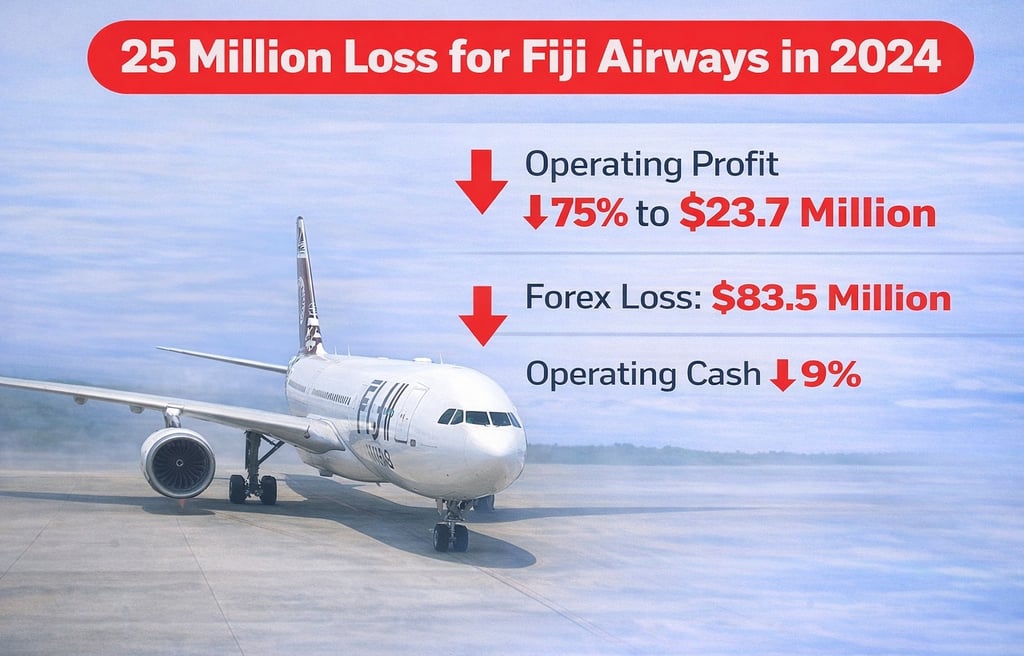
Fiji Airways failed to adapt to intensifying global aviation pressures in 2024, ultimately recording a $25 million loss, according to its 2024 annual report, as it struggled against rising fuel costs, a strengthening US dollar, and renewed competition on key international routes.
Despite boasting record revenue of $1.85 billion and increased passenger numbers, the airline’s financial performance tells a far more concerning story, one marked by shrinking margins, surging costs, and growing structural vulnerabilities, according to the annual report.
At the centre of it is a sharp collapse in underlying profitability.
Operating profit before significant items fell more than 75 per cent, from $99.8 million in 2023 to just $23.7 million in 2024, according to the annual report, showing that even before foreign exchange losses, the airline’s core business had weakened significantly.
Operating profit before significant items essentially reflects earnings before major one-off costs, and it is usually used by companies to paint a better picture than reality.
Operating expenditure rose faster than revenue, increasing by 8.6 per cent to $1.52 billion, driven by higher aircraft operating costs, a 24 per cent jump in labour expenses, and rising depreciation linked to fleet expansion, according to the annual report.
While Fiji Airways has pointed to an $83.5 million unrealised foreign exchange loss as the primary driver of its net loss, the annual report shows the airline was already under pressure long before currency movements were factored in.
The return of global airline competition further eroded performance, placing downward pressure on ticket prices and yields, even as the airline expanded routes and carried more passengers, according to the annual report.
This disconnect is reflected in another key contradiction: while revenue reached record highs, earnings performance declined, with EBITDAR falling nearly 13 per cent to $325.1 million, according to the annual report.
EBITDAR is a financial measure that shows earnings before major costs like interest, tax, depreciation, and aircraft lease payments, meaning it does not reflect the airline’s true profit after expenses.
The airline’s growing reliance on leased aircraft has also added to its financial strain. Lease-related finance costs rose sharply during the year, exposing Fiji Airways to ongoing financial pressure from fixed obligations tied to its fleet, according to the annual report.
Compounding the issue is the airline’s heavy exposure to the US dollar. With major costs such as fuel, aircraft leases, and financing denominated in USD, any strengthening of the currency has a direct and significant impact on the airline’s bottom line, according to the annual report.
Cash flow from operations also declined by over 9 per cent, while total equity fell during the year, further underscoring the weakening financial position despite strong headline figures, according to the annual report.
Although the airline continues to highlight expansion, marketing investment, and its role in supporting Fiji’s tourism sector, these strategies have yet to translate into improved financial outcomes.
The airline itself acknowledges ongoing risks, including fuel price volatility, currency fluctuations, and increasing global competition, all of which continue to place pressure on margins, according to the annual report.
Duavata News (Fiji) PTE LIMITED © 2024
☏ 3317438
📧 editor@duavata.news