Bula FC Can’t Beat Second-Tier Suburban Side, Says Lal
SPORTS
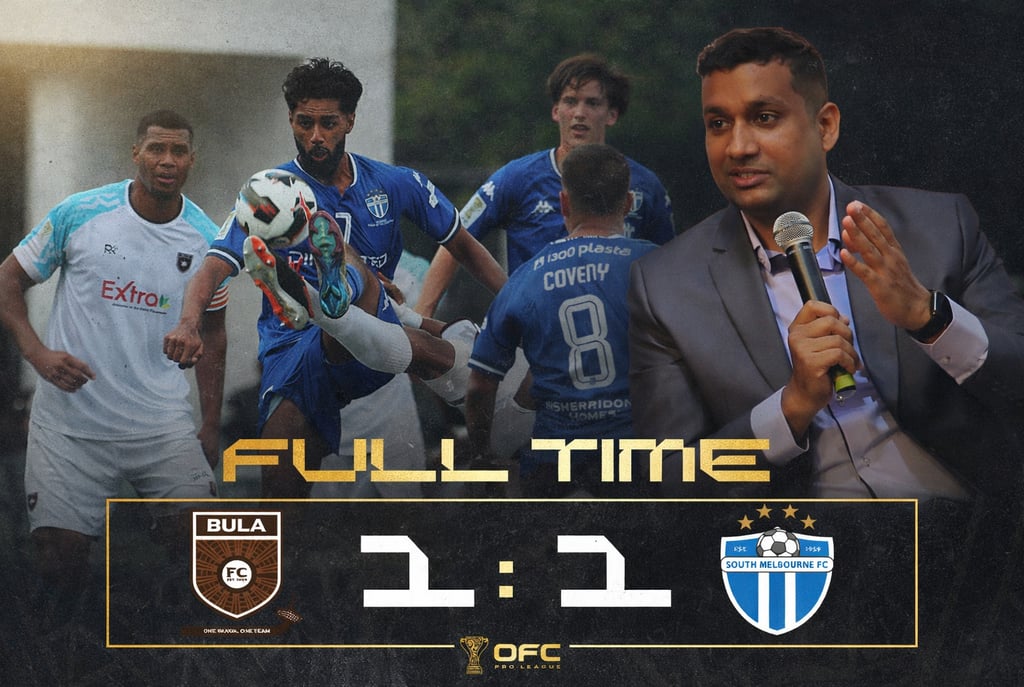
Football pundit and commentator Nilesh Lal has questioned Bula FC’s inability to beat a second-tier Australian suburban side despite having national players, and why the result was treated as something to celebrate.
Reacting to Bula FC’s 1–1 draw against South Melbourne FC, Lal gave a blunt assessment of the performance and the reaction that followed.
“Bula FC is celebrating a match where they couldn’t beat a team from a Melbourne suburb that plays in the second tier of Australia’s football league system,” said Lal.
“So, essentially, a ‘national’ team with supposedly Fiji’s top players (and then some) could not beat a team from an Australian suburb.”
Lal also raised concerns over selection and tactical decisions.
“I wonder what the coach’s plan is in sending a second-string lineup. Still experimenting?”
South Melbourne took an early lead through Andrew Mesourouni before Christopher Wasasala equalised for Bula FC, with the match ending 1–1. Despite spells of pressure, Bula FC struggled to assert control for long periods of the contest, with South Melbourne dominating possession, territory and chances created.
Another football fan, Johnny Williams, echoed similar frustrations, particularly around ball retention and style of play.
“My observation is that with the cream of talent, plus overseas players, plus our national coach, Bula FC could not keep possession for more than five touches. We are still trying to just bomb the ball upfront, expecting some miracle to happen.”
In most footballing nations, underwhelming performances by well-resourced teams are analysed and criticised extensively by the media and commentators.
In Fiji, however, it appears that for some reason there is a tight grip on media analysis and criticism, with poorly performing teams often being lauded—falsely—and almost praised simply for participating in tournaments.
The reality is that Bula FC is nowhere near winning the league and appears to have been set up more for merchandising purposes than for competitive success.
The decision to hand lucrative deals to a 38-year-old player, instead of investing in the development of new local talent capable of competing at the World Cup qualifying level, raises serious questions about the club’s long-term vision.
Last year’s embarrassing 7–0 defeat to New Zealand’s All Whites in a World Cup qualifier was one of Fiji’s worst results in recent history and clearly exposed the gulf in quality between Fiji and leading teams in the region.
Yet, there was little to no critical response from the local media. In almost any other footballing nation, such a result would have triggered serious accountability, with consequences at both coaching and association levels.
Football fans have every right to question the team’s performances because we are the customers that sponsors are trying to attract by backing the team, and genuine critique helps drive improvement rather than unquestioned praise.
Duavata News (Fiji) PTE LIMITED © 2024
☏ 3317438
📧 editor@duavata.news