Bula FC Risks Breaching FCCC Act Over Lack of Transparency
FIJI NEWSTOP STORIESSPORTS
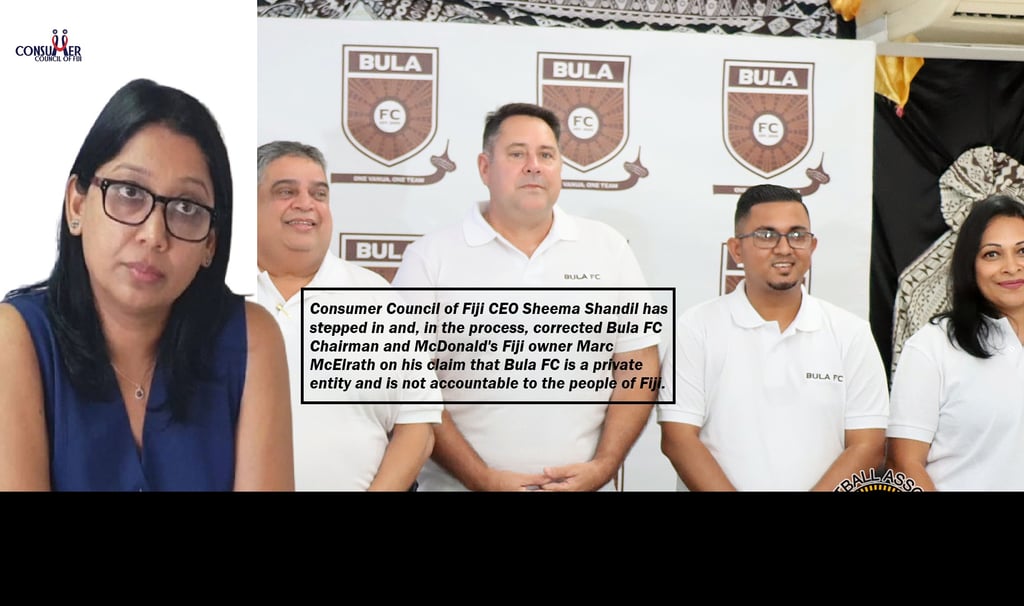
Consumer Council of Fiji CEO Sheema Shandil has stepped in and, in the process, corrected Bula FC Chairman and McDonald's Fiji owner Marc McElrath on his claim that Bula FC is a private entity and is not accountable to the people of Fiji.
Speaking exclusively to Duavata News, Shandil warned that not just Bula FC, but anyone using references to national pride or patriotism must do so without misleading the Fijian people.
“The Council’s position is that patriotic or emotive branding must not blur the distinction between a private commercial enterprise and a national, public, or representative body, unless such a relationship genuinely exists and is clearly explained to consumers,” said Shandil, highlighting that purely profit-driven private enterprises are disqualified from branding themselves as a national representative.
Any entity or individual that operates or markets goods or services in the Fijian market is answerable to its laws and people.
“Transparency becomes particularly important where marketing relies on national loyalty, public interest, or emotional appeal tied to Fiji or Fijian identity. If the absence of such information contributes to a misleading impression, it becomes a consumer protection concern."
"Transparency helps ensure that consumers understand they are engaging in a commercial transaction with a private entity,” Shandil added.
“If the use of patriotic language, national imagery, or claims of representing Fiji leads an ordinary consumer to reasonably believe that their purchase supports Fiji, Fijian football more broadly, or a public or national initiative, when in fact the proceeds benefit a private organisation, this could raise concerns."
She said that Particular care is needed where marketing targets young people, who may be more susceptible to emotional or aspirational messaging.
“Internationally, regulators consistently emphasize that the more emotive or values-based the marketing, the greater the responsibility on businesses to ensure consumers are not misled, directly or indirectly,” said the CEO.
Even as a private company, Bula FC’s merchandising and patriotic branding are bound by consumer law, including section 75 (misleading or deceptive conduct) and section 77 (false or misleading representations) of the FCCC Act 2010.
In New Zealand, similar conduct would raise issues under the Fair Trading Act 1986, particularly section 9 (misleading and deceptive conduct) and section 13 (false or misleading representations).
In Australia, that kind of marketing could fall foul of Australian Consumer Law section 29, which prohibits false or misleading representations, including claims or impressions about sponsorship, approval, affiliation, uses, or benefits.
In a landmark competition law decision, the High Court of Australia in ACCC v Air New Zealand Ltd [2017] HCA 21 confirmed that where businesses actively market to and derive demand from consumers, regulatory obligations can arise regardless of how the entity characterises itself.
The case underscores that being a “private company” does not insulate an organisation from consumer law scrutiny where public-facing marketing and consumer engagement are central to its operations.
McElrath had earlier claimed that: “As a private company, Bula FC does not have to disclose the process used to determine the club’s merchandise suppliers,” adding that the club was under no obligation to advertise or explain its decisions to the public.
The question we have now posed to Bula FC and the Fiji Football Association is whether Bula FC is now disqualified from using national pride or patriotism in its branding, since the chairman has stated that they can do whatever they want and are not accountable to football fans, while the Football Association itself have said that they are not involved with Bula FC's management.
We have also asked Fijian Competition and Consumer Commission if they will now step in as the regulator of the FCCC Act.
Duavata News (Fiji) PTE LIMITED © 2024
☏ 3317438
📧 editor@duavata.news