Most Conservative Budget in Years Signals Shift Towards Fiscal Discipline
FIJI NEWSTOP STORIES
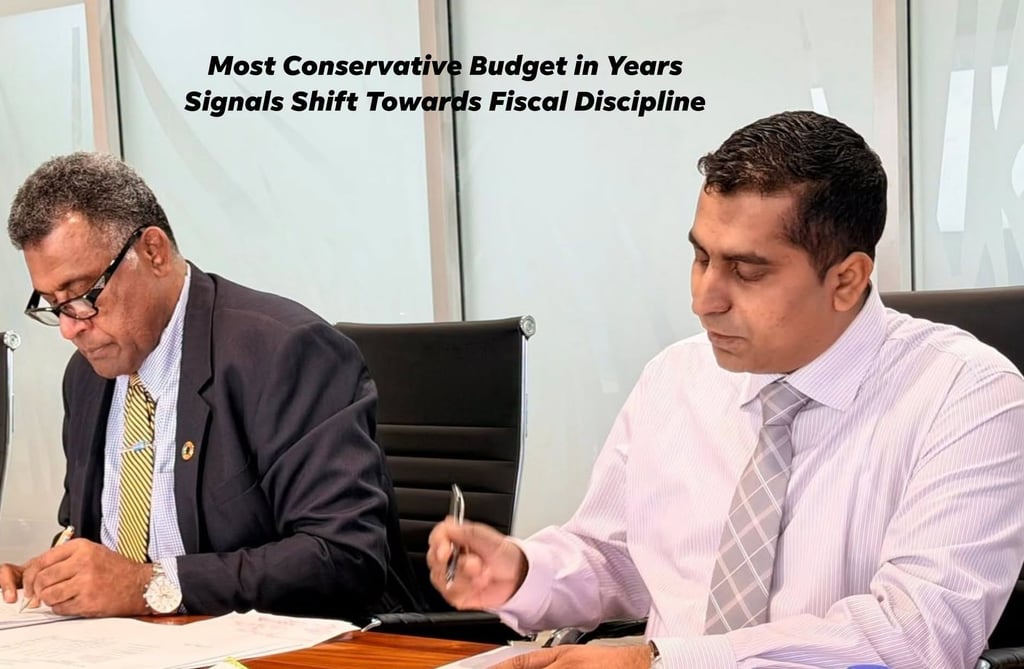
Fiji's 2026-2027 National Budget is shaping up to be one of the most conservative budgets delivered in recent years, with the Coalition Government prioritising spending restraint, debt management and long-term economic stability over major election-year giveaways.
Presenting his first budget as Minister for Finance, Honourable Esrom Yosef Immanuel described the budget as "a responsible budget for a sustainable future", warning that Fiji's public finances are under significant pressure following years of rising expenditure, increasing debt levels and recent global economic shocks.
The Government has forecast total revenue of $3.82 billion against expenditure of $4.87 billion, resulting in a budget deficit of approximately $1 billion, or 7 percent of GDP.
Public debt is projected to rise to around $12.6 billion by July next year, equivalent to 84.8 percent of GDP.
In his address, Immanuel said Fiji could no longer continue on a path of debt-fuelled expenditure growth and called for national consensus on the need to restore fiscal sustainability.
One of the most significant announcements was the Government's decision not to introduce any new taxes despite declining revenues and growing expenditure pressures.
The Finance Minister said increasing taxes would worsen cost-of-living challenges, place additional pressure on businesses and further slow economic activity.
Instead, the Government intends to focus on growing the economy, encouraging private sector investment and removing bureaucratic barriers to business expansion.
To contain spending, ministries and government agencies have been directed to reduce operational expenditure by 10 percent, including spending on travel, workshops, conferences, communications and administration.
Funding for vacant government positions has also been reduced by 50 percent, while grants provided to various state entities, commissions and organisations will be cut by 10 percent.
The 20 percent salary reduction currently applied to Ministers and Members of Parliament will remain in place for another financial year.
Despite the spending cuts, the budget includes several major investments in infrastructure and essential services.
These include the establishment of a new cancer treatment facility, upgrades to primary healthcare centres, additional bed capacity at the Colonial War Memorial Hospital and significant investment in Fiji's water and wastewater systems.
The Government has also committed funding towards four major bridge replacement projects, flood mitigation initiatives and efforts to reduce water losses across the country.
The budget places particular emphasis on increasing capital expenditure, with $876 million allocated for infrastructure and development projects in the coming financial year.
The Government says it aims to gradually shift spending away from day-to-day operating costs and towards long-term investments that improve national productivity and economic growth.
The Finance Minister also indicated that recent international developments could bring relief to consumers in the months ahead.
He said progress towards peace in the Middle East and falling global oil prices should result in reductions in domestic fuel prices, with announcements expected in the coming weeks.
Economic growth for 2026 has been revised downward to 1.5 percent, largely due to global economic uncertainty and the recent fuel price shock.
However, Government remains optimistic that growth will strengthen over the medium term through increased private sector investment and major infrastructure projects already in the pipeline.
According to the budget, Fiji currently has 254 active investment projects worth approximately $8.9 billion across various sectors of the economy.
While some may criticise the absence of major new spending initiatives, analysts are likely to view the budget as a deliberate attempt to restore fiscal discipline and confront the country's growing debt burden.
The budget's central message is clear: Fiji must live within its means, control expenditure, grow the economy and invest strategically if it is to secure a more stable and sustainable future.
Duavata News (Fiji) PTE LIMITED © 2024
☏ 3317438
📧 editor@duavata.news