Nemani Challenges HR Professionals to Identify Leaders
FIJI NEWS
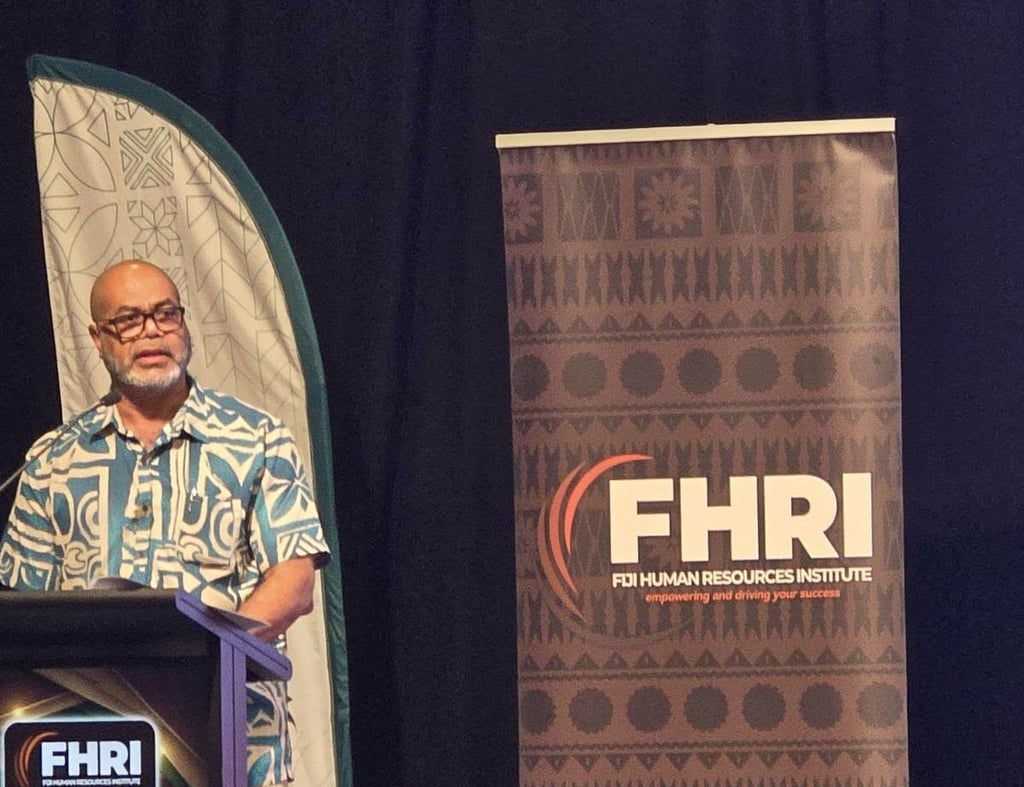
The Permanent Secretary for Employment, Productivity and Workplace Relations, Jone Maritino Nemani, has challenged human resources professionals across Fiji to take greater responsibility in identifying and shaping leadership — warning that the country’s leadership crisis is, at its core, a human capital failure.
Speaking before approximately 400 HR practitioners, board directors, chief executives and senior government officials at the 21st BSP Life FHRI Annual Convention in Nadi, Mr Nemani said leadership character must be treated as a central function of the HR profession, not an afterthought.
“When leadership failures are traced back to their origin, the issue is rarely technical. It is almost always a character gap that no one in the system was prepared to confront. That is a human capital failure — and it places responsibility squarely on this profession.”
Referencing data showing anti-corruption complaints rising sharply from 318 to 681 within a year, alongside Fiji’s Transparency International score of 55 out of 100, Mr Nemani said the pattern of governance concerns across public institutions reflects deeper systemic weaknesses.
He pointed to failures in selection, induction, conduct enforcement and accountability — all core HR functions — as underlying drivers of the problem.
In one of the address’s most compelling points, Mr Nemani highlighted Fiji’s PALM scheme workers as an unlikely but powerful model of character-led leadership.
With more than 10,500 Fijians working in Australia and 4,600 in New Zealand — and remittances projected to reach $1.4 billion — he said these workers are deliberately prepared with strong values, conduct expectations and accountability frameworks before representing Fiji abroad.
From communities pooling funds for school buses, to villages establishing their own pre-departure training programmes, and workers returning with professional qualifications — he said these examples demonstrate the kind of leadership standards Fiji should expect domestically.
“If we prepare seasonal workers for character and accountability before they represent Fiji abroad, why are we not demanding the same standard from those who lead our institutions at home?”
Mr Nemani outlined five key expectations for the HR profession: treating values as a disciplined and measurable function; enforcing conduct frameworks consistently at all levels; advocating for stronger institutional authority to act; applying the same preparation standards used in the PALM scheme to senior leadership appointments; and confronting the real cost of inaction.
He warned that failure to act would continue to erode trust, weaken institutions and drive talent loss.
“The standard we set for our seasonal workers must be the floor — not the ceiling — for leadership at home. The question is not whether Fiji has a leadership crisis. The question is what we do about it.”
Mr Nemani is a former Fiji national football captain and currently serves as Chairman of the Suva Rugby Union. He brings decades of professional experience in human resources to his role.
The address was delivered at the 21st BSP Life FHRI Annual Convention hosted by the Fiji Human Resources Institute.
Duavata News (Fiji) PTE LIMITED © 2024
☏ 3317438
📧 editor@duavata.news