People Support Electricity Price Increase, Says FCCC
FIJI NEWS
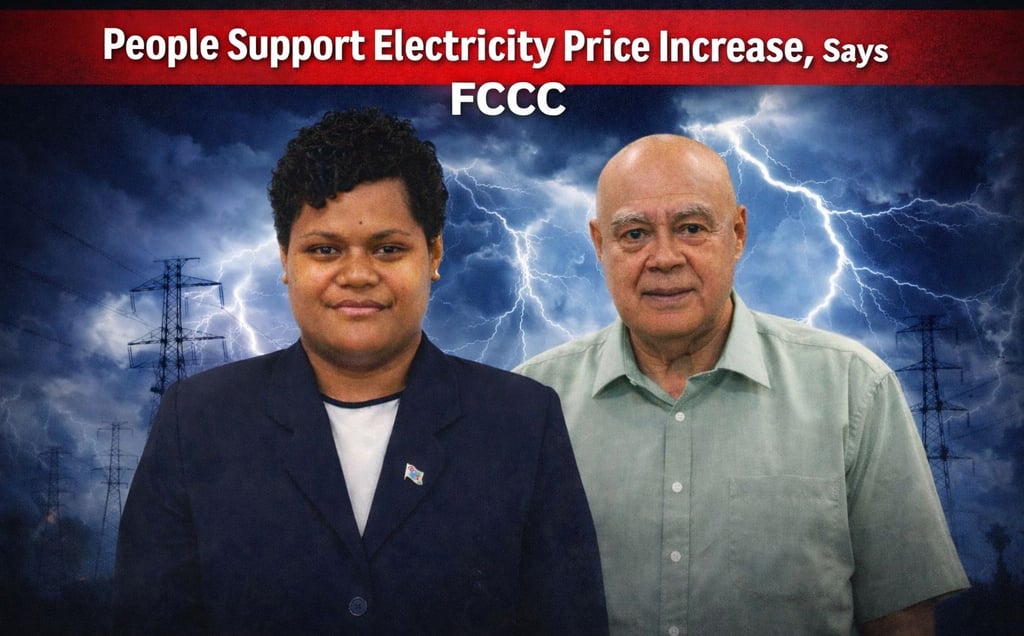
The Fijian Competition and Consumer Commission says most participants in its electricity tariff consultation support the rationale for a price increase, but the claim, attributed to FCCC Chairperson Cecil Browne, is already being challenged by members of the public who are demanding the release of the full raw consultation data.
In a media release issued on 12 February and signed by Chairperson Cecil Browne, the FCCC said it received 975 submissions during its 21-day public consultation on the electricity tariff review.
The Commission reported that 51 percent of participants supported the rationale behind a tariff adjustment, while 37 percent opposed any increase, with the remainder proposing additional safeguards and policy measures.
FCCC also noted that the majority of the 51% recommended that the tariff increase be implemented in a phased and measured manner.
However, the headline figures have triggered immediate pushback online, with members of the public questioning how the percentages were calculated and how different forms of feedback were measured and combined.
“Nobody ever gets to see the data you collected, how you analyzed or interpreted it and are now reporting the information. I have trust issues with FCCC. Your consultation sessions did not target the underprivileged or economically disadvantaged communities, nor did you consider remote geographical communities. How did you even arrive at that percentage?” Nalini Kumar said.
“Why don’t you release all the written submissions and transcripts? If what you say is correct, then the public should be able to arrive at the same conclusion,” Aoneesh Sharma said.
Others questioned whether vulnerable, rural, and economically disadvantaged communities were properly reached during the consultation period and whether participants were given a real opportunity to question and challenge the proposed increases.
Despite claiming majority support for the tariff rationale, the FCCC has deferred its final tariff authorisation decision until 30 April 2026, saying further engagement is needed with government on support measures and financing options before a final determination is made.
The FCCC said the feedback came from written submissions, focus group sessions with business and interest groups, and structured oral consultations and surveys involving consumers and other stakeholders.
The consultation process itself has previously drawn heavy criticism.
People’s Alliance General Secretary Sila Balawa had earlier slammed several FCCC consultation sessions, describing them as poorly run and not reflective of genuine public engagement.
He said some attendees reported being given little opportunity to ask questions or express views, with sessions operating more like briefings than consultations.
There has also been past controversy over access, including an incident where media organisations were barred from attending a stakeholder consultation session, a move that drew criticism after the stakeholder group, FCEF, publicly disputed that it had requested a closed meeting.
We have asked FCCC to provide us with the raw data.
Duavata News (Fiji) PTE LIMITED © 2024
☏ 3317438
📧 editor@duavata.news