
Nilesh Lal Calls Fijians ‘ignorant’ While Endorsing Incorrect Economic Argument
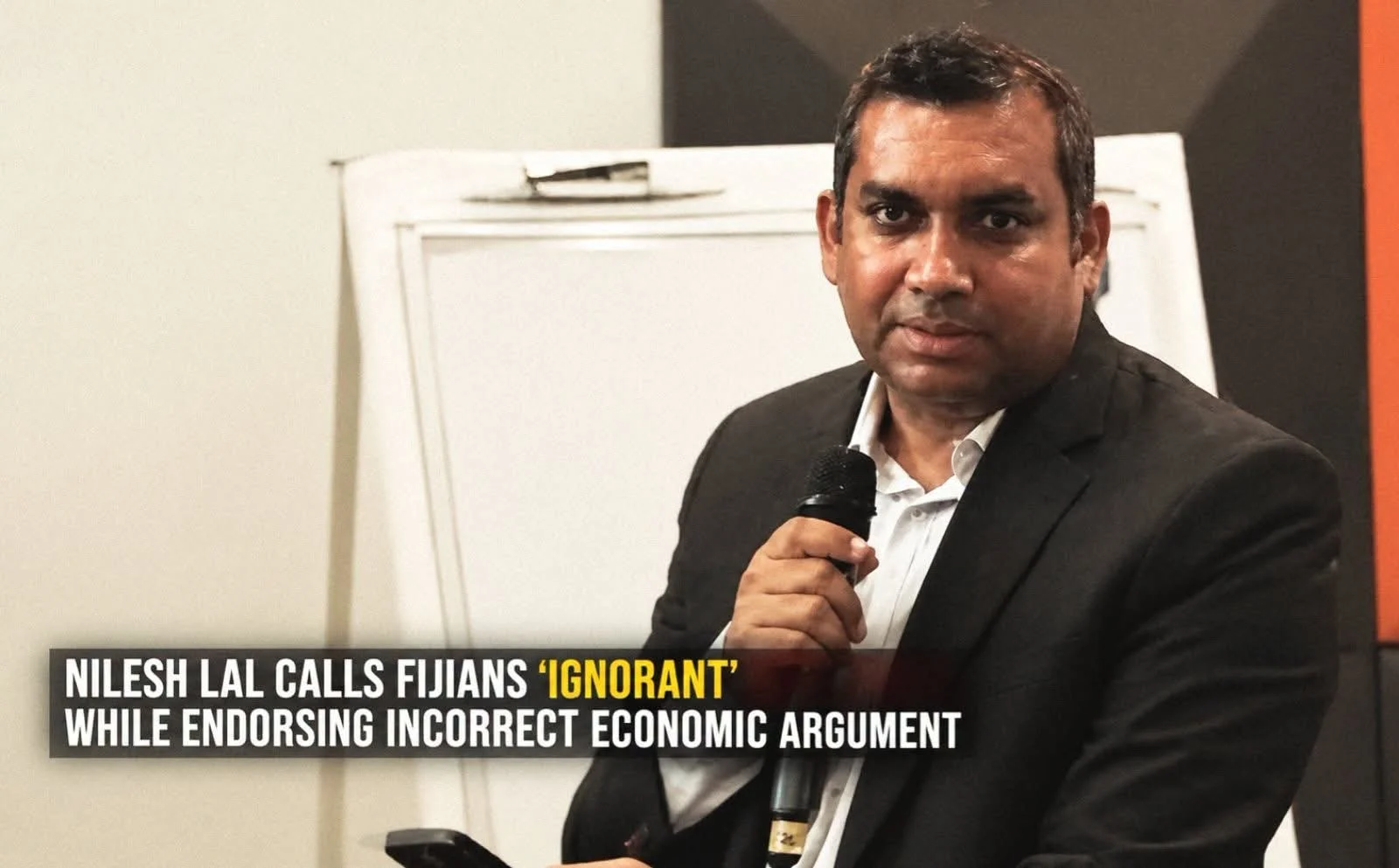
Centre for Democracy and Dialogue (CDD) Chief Executive Nilesh Lal has accused Fijians of economic ignorance while agreeing with a Facebook comment containing incorrect claims about foreign reserves.
Facebook user Isireli Fa claimed Fiji’s foreign reserves “should be about 2–3 months worth of imports” and that reserves exceeding this level meant money had nowhere to be deployed because the economy was “stagnant”.
Lal replied “agreed”, before saying the reaction to Fiji’s $3.9 billion reserve position showed “the degree of ignorance amongst Fijians” about the national economy, while also accusing government of being unscrupulous.
However, in this particular case, it appears it was Lal, not the Fijians he criticised, who had the economic concepts wrong.
Our sources in the finance sector tell us, and basic economic principles confirm, that the three month figure is traditionally used as a minimum rule of thumb for reserve adequacy, not a maximum. The IMF itself describes three months as a benchmark and says the appropriate level varies depending on a country’s circumstances.
This is where the argument Lal agrees with falls apart.
Having more than three months of import cover does not mean an economy is stagnant. In fact, IMF analysis has found that countries with reserves above three months have generally been better able to absorb external shocks.
More fundamentally, the argument Lal agrees with gets the basic concept almost exactly backwards by treating what is traditionally a minimum safety buffer as though it were a maximum limit.
Similarly, the suggestion that reserves above three months indicate an economy is stagnant confuses foreign reserves with money available for domestic lending and investment.
Foreign reserves are external assets held to meet international payment obligations and provide protection against external shocks. Domestic banking liquidity is a separate measure.
In Fiji, banking system liquidity currently stands at approximately $2.1 billion, with the Reserve Bank saying this is helping maintain relatively low lending rates. Private sector credit is also continuing to increase across several sectors.
The RBF itself describes Fiji’s current 5.5 months of import cover as adequate, not evidence of stagnation.
Senior figures in Fiji’s private financial sector have expressed surprise to Duavata News at what they described as a basic misunderstanding of economic concepts.
Lal’s organisation has increasingly positioned itself in Fiji’s economic debate, including through its State of the Fijian Economy Dialogue, which attracted criticism as a “talkfest”.
The Centre for Democracy and Dialogue was formerly known as Dialogue Fiji.
More from Duavata
FCCC Advises Taxi Operators to Wait Before Recalibrating Meters

Fiji Women’s Chess Team Records 3-1 Victory Over Bhutan
President Lalabalavu Calls for Peace, Climate Action and UN Reform at UNGA81

Young Fijian Aerobic Gymnasts Bring Home Medals from Australia